Hashes, signatures and encryption
Objective
Distinguish integrity, authorization and confidentiality.
Understanding the topic
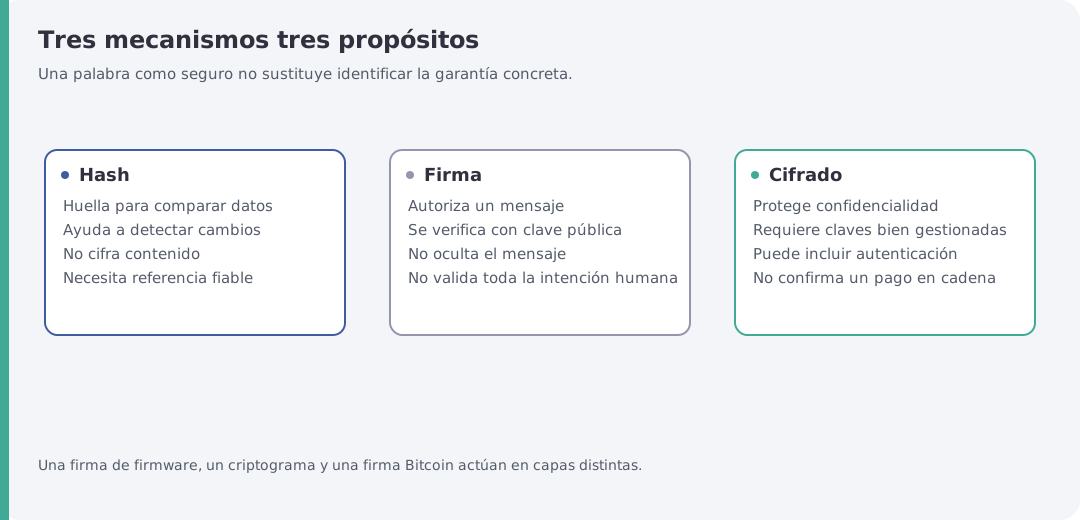
A hash transforms data into a fixed-length fingerprint. Comparing it with a known fingerprint helps detect changes. It does not encrypt the file or identify its publisher by itself. If you download both the file and its hash from a compromised page, an attacker may have replaced both.
A private key can create signatures. The corresponding public key can verify them. A signature binds an authorization to a specific message under the algorithm and its rules. It does not conceal what was signed. In Bitcoin, a valid signature can be one of the conditions required to spend an output.
Encryption aims to make content readable only to someone with the appropriate capability. Authenticated encryption also detects alterations. In Cuvex, cryptograms protect secrets, signed transactions authorize spending and encrypted channels transport messages. All three use cryptography for different purposes.
A human-entered password usually passes through a derivation function before use as a cryptographic key. “AES-256” describes the algorithm and key size. It cannot turn a predictable password into a strong choice. Generation, implementation, storage, display and recovery all contribute to overall security.
A complex-looking QR code is no assurance of safety. Understand what it contains, who created it and how the application will use it. Before accepting an action, ask the tutor to explain its purpose without asking for the private data.
Practice
- Match “detecting a file change,” “hiding a seed” and “authorizing a payment” to a hash, encryption and a signature.
- Change one letter in fictitious text and observe the change in its hash. Use no secrets for this demonstration.
- Explain how a transaction can be both public and signed.
Show what you know
Describe the property you need and which mechanism provides it. Avoid using “encrypted” to describe every kind of security.
Common question
Does a firmware hash certify that the firmware has no bugs? No. It identifies bytes if the reference is reliable. An audit, a manufacturer’s signature and a physical test answer different questions.
Pause point
Save the three matches from the exercise.
Reading, self-assessment and physical practice are different. This result is not a certificate.